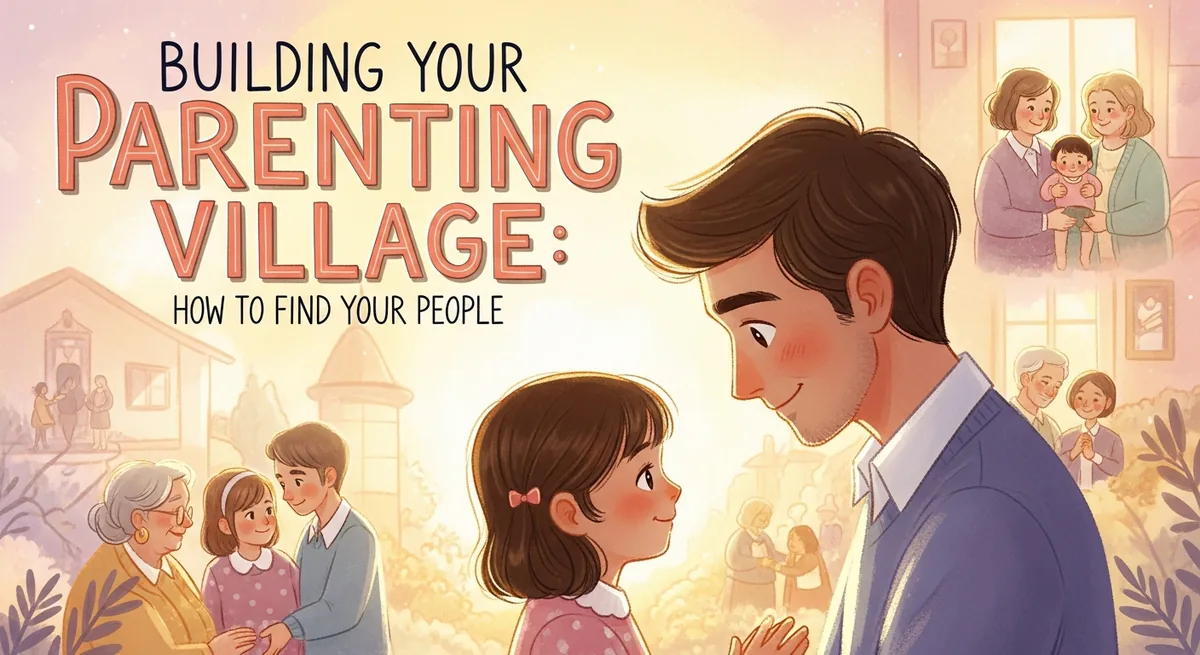
Building Your Parenting Village: How to Find Your People
Building Your Parenting Village: How to Find Your People
They say it takes a village to raise a child. But nobody tells you how to actually find that village—especially when you're an adult with a full-time job, possibly new to an area, and suddenly have zero time to socialize because there's a baby attached to you 24/7.
The isolation of early parenthood is real and brutal. Your pre-baby friends don't relate to your new reality. Your schedule makes spontaneous socializing impossible. You're desperate for connection but too exhausted to seek it out. Meanwhile, social media shows other moms at playgroups looking effortlessly connected, making you feel even more alone.
Here's the truth: most of those 'connected' parents worked hard to build their village. It didn't happen automatically. They put themselves out there, joined groups, showed up repeatedly, and gradually formed friendships. Your village won't appear magically—but it can be built intentionally, even if you're introverted, busy, or new to parenthood.
This guide will show you exactly how to build your parenting support network from scratch. You'll learn where to meet other parents, how to turn acquaintances into friends, what to do if you're introverted or socially anxious, and how to maintain friendships despite the chaos of parenting.
Whether you're craving mom friends desperately or you're skeptical about whether you even need a village, these strategies will help you create the support system that fits YOUR life and personality. Because parenting is hard enough—you shouldn't have to do it alone.
Understanding the Fundamentals: What You Really Need to Know
Before we dive into specific strategies and actionable advice, let's establish a solid foundation of understanding. Understanding why parenting isolation happens helps you overcome it without shame or self-blame.
The Core Principles That Matter Most
Modern parenting is uniquely isolating. Previous generations had multi-generational homes, close-knit neighborhoods, and communal childcare. Today, many parents live far from family, in neighborhoods where people barely know each other, working full-time while managing households alone. Add the performance pressure of social media, and you're set up for loneliness. This isn't personal failure—it's structural. The 'village' doesn't exist by default anymore. You have to intentionally create it.
What Research and Experience Tell Us
Research on parental isolation shows it's a significant risk factor for postpartum depression, anxiety, and relationship strain. But studies also show that even one supportive parenting friendship significantly improves mental health outcomes. You don't need a huge social circle—you need one or two people who get it. Quality matters far more than quantity.
Common Myths We Need to Address
Myth: 'If I was more outgoing, I'd have more friends.' Reality: Introverts can build villages too—they just do it differently (deeper one-on-one connections vs. group activities). Myth: 'Real friendships happen naturally, not through organized groups.' Reality: Adult friendships almost always require intentional effort and repeated exposure. Nothing wrong with that. Myth: 'Other moms have it all figured out and I'm the only one struggling.' Reality: Everyone's faking it. The mom who looks perfectly put-together is also lonely and overwhelmed.
Comprehensive Strategies That Actually Work
Now that we've established the fundamentals, let's explore proven strategies you can implement immediately. These approaches come from years of research, expert recommendations, and real parent experiences.
Strategy 1: Show Up Repeatedly to the Same Places
Adult friendships require repeated, unplanned interactions—seeing the same people regularly in casual settings. This is why workplaces create friendships: you're thrown together repeatedly without pressure. Recreate this by showing up to the same baby class, library storytime, park, or playgroup consistently. Go weekly for 8-12 weeks. Friendships develop through familiarity and repeated low-stakes exposure, not instant connection.
💡 Pro Tip: Pick one or two regular activities and commit for at least 8 weeks. Don't expect instant best friends at week one. By week 8, you'll likely have friendly acquaintances who could become friends.
Strategy 2: Initiate (Even When It's Scary)
Waiting for others to befriend you is a passive strategy that rarely works. You have to initiate: 'Hey, want to exchange numbers?' 'Our babies are the same age—want to meet at the park sometime?' 'I'm going to the coffee shop after this—join me?' Most parents are desperate for connection and will say yes. The ones who say no aren't rejecting you—they're busy or overwhelmed. Keep asking.
Real Example: Maya went to a baby music class for 6 weeks and chatted with the same two moms each time but never exchanged info. Week 7, she finally said, 'Can we exchange numbers and meet outside class?' Both moms said yes immediately and admitted they'd been hoping someone would suggest it. Now they're best friends. Someone has to make the first move—be that someone.
Strategy 3: Use Online Communities to Find In-Person Friends
Transition online connections to in-person as quickly as possible. Screen friendship is better than nothing, but real connection happens face-to-face.
Strategy 4: Be Vulnerable About Your Struggles
You don't have to overshare with everyone—save deep vulnerability for people who've earned it. But mild honesty ('Parenting is harder than I expected') invites real connection.
Strategy 5: Diversify Your Village
Your village doesn't have to be all parent friends. Include: other parents for shared experience, non-parent friends for perspective and non-baby identity, family (if available and supportive), online communities for 3 AM support, professionals (therapists, parenting coaches) when needed, and neighbors for practical help. Different people meet different needs. Don't expect one person or group to meet all your needs.
Real Challenges and Practical Solutions
Let's address the most common obstacles you'll face and provide concrete solutions that work in real life, not just in theory.
Challenge 1: Feeling Too Introverted to Put Yourself Out There
The Problem: You're exhausted by socializing, overwhelmed by group settings, and the thought of making small talk with strangers while managing your baby feels impossible.
The Solution: Introverts need villages too—just different ones. Skip big playgroups and focus on one-on-one coffee dates. Text friendships count. Join quieter activities like library storytimes instead of loud music classes. Aim for one social interaction weekly, not daily. Quality over quantity. And remember: other introverted parents are also desperately hoping someone else initiates so they don't have to.
Challenge 2: All Parenting Groups Feel Cliquey
The Problem: You go to a playgroup and everyone already knows each other. They're chatting in established groups while you stand awkwardly on the sidelines with your baby, feeling like you're back in middle school.
The Solution: Cliques aren't usually intentional exclusion—they're just established friendships. Break in by targeting one person (not a whole group) and starting a conversation. Ask questions: 'Is this your first time here?' 'How old is your baby?' Most people respond warmly to friendly approaches. If the group truly is unwelcoming, find a different one. Not every group will be your fit, and that's okay.
Challenge 3: Your Pre-Baby Friends Don't Get It Anymore
The Problem: Your childless friends complain about being tired after a night out. You're surviving on 3 hours of interrupted sleep and can't remember the last time you showered. You feel like you're on different planets.
The Solution: Some pre-baby friendships won't survive this transition, and that's sad but normal. Others will adapt if you're honest: 'I want to stay connected, but I need you to understand my life looks completely different now. Can we figure out how to maintain our friendship despite the changes?' Propose specific adaptations: shorter visits, baby-friendly activities, video chats during nap time.
Challenge 4: No Time or Energy to Maintain Friendships
The Problem: You finally make a potential friend, but then weeks pass without contact because you're drowning in survival mode. The friendship fizzles before it even starts.
The Solution: Lower your friendship maintenance expectations. Texting counts as connection. Parallel play playdates where you barely talk but share space counts. Missing weeks and then picking back up counts. Parents understand. Send a text: 'I've been MIA because life is chaos, but I value our friendship. Can we find a sustainable rhythm?' Most parent friends will relate and work with you to find something manageable.
What the Experts Want You to Know
Pediatrician Perspective
As a pediatrician, I see how parental isolation affects both parents and children. Isolated parents have higher rates of depression and anxiety, which impacts their ability to be present with their children. But parents with support systems—even small ones—show better mental health, more patience, and greater parenting confidence. Your social health is part of your family's health. Building a village isn't optional—it's preventive medicine.
Child Development Research
Studies on parenting support networks show that perceived support matters more than actual support. Having one friend you could call in crisis is more protective against depression than having ten casual acquaintances. Focus on depth, not breadth. Also, giving support (not just receiving it) increases feelings of connection and purpose. Parent friendships are reciprocal—you're not just taking, you're contributing too.
Wisdom from Experienced Parents
I surveyed isolated parents who successfully built villages. Common patterns: they initiated even when scared, showed up consistently to the same activities, were vulnerable about struggles, didn't take initial awkwardness personally, and gave friendships time to develop (8-12 weeks minimum). The parents who stayed isolated? They waited for others to reach out, gave up after one awkward interaction, or expected instant deep connection. Building a village requires persistence and tolerance for initial discomfort.
Critical Mistakes to Avoid
Learn from others' experiences. Here are the most common pitfalls and how to avoid them:
❌ Mistake 1: Waiting for Other People to Initiate
Why It's Harmful: Everyone's waiting for someone else to make the first move. If you wait for others to invite you, befriend you, or organize hangouts, you'll likely wait forever. Other parents are just as scared and overwhelmed as you.
Do This Instead: Be the initiator. Exchange numbers first. Suggest meetups first. Start the group text. Yes, it's vulnerable and sometimes people say no. But far more often, they're relieved someone finally took initiative. The person who organizes becomes the center of the social circle—be that person.
❌ Mistake 2: Expecting Instant Best Friendship
Why It's Harmful: You meet a mom at the park, have a nice chat, and then... nothing. You feel rejected and give up. But adult friendships take time—usually 8-12 interactions before you feel genuinely comfortable together. Expecting instant connection sets you up for disappointment.
Do This Instead: Lower your expectations for individual interactions. Focus on consistency over intensity. Friendly small talk at week 1 can become deeper sharing by week 8 if you keep showing up. Give friendships time to develop before deciding they're not working.
❌ Mistake 3: Only Socializing When You Feel Good
Why It's Harmful: You skip playgroup because you're tired, or you cancel coffee because baby had a rough night, or you don't go to the park because you look terrible. You're waiting to feel ready, which means you rarely go. Friendships can't develop if you never show up.
Do This Instead: Show up especially when you feel like garbage. Those are the times you need support most, and they're also when you're most relatable to other struggling parents. Some of the best parenting friendships form when both people show up looking terrible and bond over shared disaster.
❌ Mistake 4: Dismissing Online Community as 'Not Real Friendship'
Why It's Harmful: You tell yourself that online mom groups or texting friendships 'don't count' as real connection. So you don't engage with online communities and deprive yourself of an accessible support source.
Do This Instead: Online community is real community. A mom who texts you encouragement at 2 AM when you're struggling is a real friend, even if you've never met in person. Use online spaces for support, especially during survival phases when in-person socializing is impossible. When you have more bandwidth, translate some online connections to in-person friendships.
Your Questions Answered
Here are the most frequently asked questions, answered comprehensively:
How do I make mom friends when I'm an introvert?
Focus on one-on-one connections instead of groups. Coffee dates, parallel play playdates, texting friendships—all great for introverts. You don't need to attend loud playgroups or big events. Find quiet activities (library storytimes, nature walks) where low-key connection is possible. Also, being introverted doesn't mean you can't initiate—it just means you need recovery time after. Schedule social time with built-in recovery time after.
What if I go to groups and can't connect with anyone?
Not every group will be your people. Try multiple different groups (library storytimes, baby yoga, new parent groups at hospitals, religious communities, online meetups from local Facebook groups). After 8-10 weeks, if you're still not clicking with anyone, try a different group. It's not you—it's fit. Keep trying until you find your people. They exist.
How do I maintain friendships when I'm barely surviving?
Lower the bar dramatically. Texting is friendship maintenance. Showing up to the same park weekly even if you barely talk is connection. Missing weeks and then picking back up is normal. Parent friendships have to be low-maintenance and flexible because everyone's overwhelmed. The friends who last are the ones who understand and don't take it personally when you disappear for a while.
What if my partner doesn't understand why I need mom friends?
Explain that you need friends who understand this specific life stage. Your partner, no matter how supportive, can't fully relate to certain experiences (breastfeeding struggles, postpartum recovery, being home with baby all day). Mom friends aren't replacing your partner—they're filling a different need. Most partners understand this framing better than 'I need to get away from you.'
Should I fake having it together or be honest about struggling?
Be honest. When you pretend everything is perfect, you attract surface-level friendships with other people pretending. When you're real ('This is so much harder than I expected'), you attract genuine connection with people who also struggle. Vulnerability creates depth. You don't have to overshare immediately, but mild honesty ('This week was rough') opens the door to real friendship.
What if I'm in a new city and know literally no one?
This is hard but very doable. Focus on: joining multiple regular activities (library storytimes, baby classes, park visits), using online groups to find in-person meetups (local parent Facebook groups, Peanut app, Meetup.com), and being extra proactive about initiating (you have nothing to lose—you don't know these people anyway). Also, new parents are often new to areas (moved for jobs, etc.), so you're not alone in starting from scratch.
Your Step-by-Step Action Plan
Ready to implement everything you've learned? Follow these concrete steps:
- Identify 2-3 Regular Activities: Research: library storytimes, baby classes (music, yoga, swimming), parent groups at hospitals, religious communities, or parks with regular morning crowds. Pick 2-3 you can realistically attend weekly.
- Commit to 8 Weeks of Consistent Attendance: Put your chosen activities on your calendar for the next 8 weeks. Commit to showing up even when you don't feel like it. Friendships develop through repeated exposure, not one-time visits.
- Join Local Online Parent Groups: Search Facebook for '[Your City] Moms' or '[Your Neighborhood] Parents.' Join 2-3 groups. Read posts to get a feel, then introduce yourself and ask about meetups or playgroups.
- Initiate One Conversation Each Outing: At each activity, start one conversation. It can be simple: 'How old is your baby?' 'Is this your first time here?' 'Where do you live nearby?' Small talk is the entry point to friendship. Practice being the initiator.
- Exchange Contact Info With One Person: By week 4, aim to exchange phone numbers or Instagram with one person you've chatted with multiple times. Say: 'I'd love to stay in touch—can I get your number?' Most people will say yes.
- Suggest One Outside Hangout: Once you have someone's number, suggest meeting outside the group activity: 'Want to get coffee after library time next week?' or 'Let's meet at the park Saturday morning.' Friendships deepen through varied contexts.
- Be Vulnerable About Your Experience: When conversations move past small talk, share something real: 'I'm finding this harder than I expected' or 'I was really isolated before finding this group.' Vulnerability invites deeper connection and signals it's safe for others to be real too.
Moving Forward with Confidence
Building your parenting village from scratch is possible, even if you're introverted, new to an area, or socially anxious. It requires putting yourself out there repeatedly, tolerating initial awkwardness, and giving friendships time to develop. But the payoff—having people who get it, who you can text at 2 AM, who make this isolating experience feel less lonely—is worth every uncomfortable moment.
Remember: everyone at that playgroup, library storytime, or baby class is also hoping to make friends. They're also wondering if they're the only one struggling. When you initiate, when you're honest, when you show up consistently, you're not just helping yourself—you're creating community for everyone.
Your village might not look like you imagined. It might be smaller, quieter, more online, or more diverse than the idealized Instagram version. That's okay. The right village for you is the one that actually supports you, not the one that photographs well. Focus on finding your people, not performing having people.
And if you're still struggling after trying everything in this guide, that's when to seek professional help. Therapists, parenting coaches, and postpartum support organizations can help you work through barriers to connection. You don't have to figure this out alone—ironically, building your village sometimes starts with asking professionals for help building your village. Whatever it takes, don't stay isolated. You deserve support.