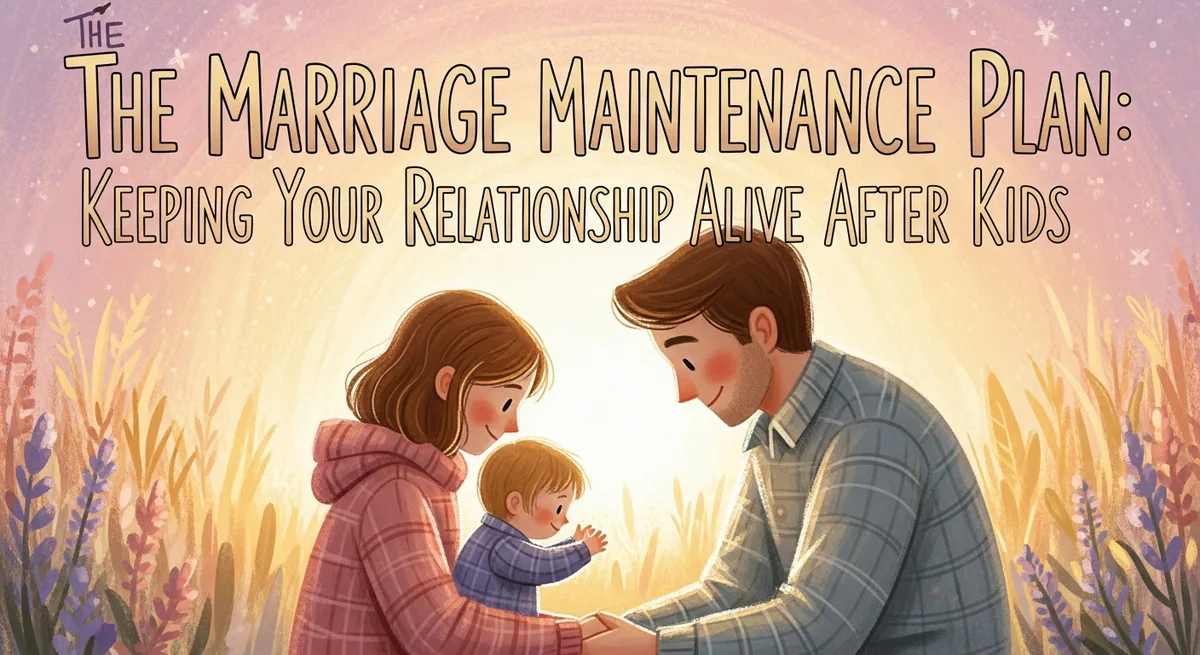
The Marriage Maintenance Plan: Keeping Your Relationship Alive After Kids
The Marriage Maintenance Plan: Keeping Your Relationship Alive After Kids
You used to have long conversations over dinner. Now you grunt at each other while passing a screaming baby back and forth. You used to go on dates. Now you fall asleep mid-sentence at 8 PM. You used to be romantic partners. Now you're exhausted co-managers of a tiny, demanding human.
If this sounds familiar, you're not alone. Research shows marital satisfaction drops significantly after having children and doesn't recover until kids leave home—unless couples actively work to maintain their relationship. The transition to parenthood is one of the most stressful experiences a couple faces, and many relationships don't survive it intact.
Here's what no one warns you about: having a baby doesn't bring you closer automatically. In fact, it often creates distance—resentment over unequal labor, exhaustion that kills intimacy, different parenting philosophies causing conflict, and the loss of your pre-baby identity as a couple. You're not failing if you're struggling. You're experiencing something completely normal.
But normal doesn't mean inevitable. Couples who consciously prioritize their relationship during the baby years emerge with stronger partnerships. They understand that a healthy marriage benefits their children far more than sacrificing their relationship to be 'perfect' parents. They build maintenance practices that keep their connection alive even during the hardest phases.
This guide provides a practical marriage maintenance plan—concrete strategies to protect and nurture your relationship while raising young children. Whether your relationship is thriving and you want to keep it that way, or you're struggling and need help reconnecting, these tools will make a difference.
Understanding the Fundamentals: What You Really Need to Know
Before we dive into specific strategies and actionable advice, let's establish a solid foundation of understanding. Understanding why parenting is so hard on relationships helps you address root causes rather than just symptoms.
The Core Principles That Matter Most
The transition to parenthood changes every aspect of your life simultaneously: sleep, finances, free time, identity, responsibilities, and intimacy. You're not just adding a baby to your existing life—you're creating an entirely new life. This would be difficult even if you were rested and had support. But you're doing it exhausted, often isolated, and while navigating massive hormonal and identity shifts. Of course your relationship suffers. The question isn't whether it'll be hard. It's whether you'll work together through the hardness or let it drive you apart.
What Research and Experience Tell Us
The Gottman Institute, which has studied relationships for decades, finds that 67% of couples experience a significant drop in marital satisfaction during the first three years after baby. The couples who buck this trend share common practices: they maintain friendship and intimacy even in small ways, they divide labor in ways both perceive as fair, they support each other as parents rather than competing or criticizing, and they intentionally preserve time together as partners, not just parents.
Common Myths We Need to Address
Myth: 'If we were really meant to be together, it wouldn't be this hard.' Reality: All couples struggle after having kids. Difficulty doesn't mean incompatibility. Myth: 'We need to put the baby first always, even if it means ignoring our relationship.' Reality: Your relationship is the foundation of your family. A strong partnership benefits your children. Myth: 'We'll reconnect when the kids are older.' Reality: Waiting years to address relationship issues usually means there's no relationship left to reconnect to. Start now.
Comprehensive Strategies That Actually Work
Now that we've established the fundamentals, let's explore proven strategies you can implement immediately. These approaches come from years of research, expert recommendations, and real parent experiences.
Strategy 1: The Daily Six-Minute Check-In
Every day, no matter how exhausted you are, spend six minutes connecting. Two minutes each partner talks uninterrupted about their day (not logistics—feelings, experiences, thoughts). Two minutes asking each other one meaningful question ('What was your high and low today?'). This is not much time, but it's enough to maintain the baseline friendship and awareness of each other's inner lives. Without this, you become roommates managing a household instead of partners sharing a life.
💡 Pro Tip: Do this during baby's first nap or after bedtime. If baby won't cooperate, have the conversation via text or voice memo. It's the intention that matters, not the perfect setting.
Strategy 2: Weekly Marriage Meetings
Once a week, have a 20-minute 'marriage meeting' where you discuss logistics (calendar, finances, chores), appreciate each other (name one thing your partner did well this week), and address any concerns (without blame). This prevents resentment from building when frustrations go unspoken. It's a designated time to talk about the hard stuff so you're not ambushing each other with complaints at 10 PM when you're both exhausted.
Real Example: Tom and Jess started weekly meetings when their baby was 3 months old. In the first meeting, Jess realized Tom had no idea she felt overwhelmed by nighttime wake-ups because she'd never directly asked for help—she'd just been silently resentful. Tom had assumed she preferred handling nights herself. One conversation fixed weeks of tension. Now they troubleshoot issues before they explode.
Strategy 3: Protect Physical Intimacy (Even Without Sex)
If you're both okay with low/no intimacy, that's fine. But if one partner is feeling disconnected, address it openly. Don't let resentment build silently.
Strategy 4: Monthly Date Nights (Even At Home)
If you can't afford babysitters, trade with other parent friends or do at-home dates after bedtime. Something is better than nothing.
Strategy 5: Divide Labor Fairly (And Revisit Often)
Resentment over unequal labor division is the #1 relationship killer after having kids. What feels fair to one partner often feels wildly unfair to the other. The solution isn't achieving perfect 50/50 (impossible with breastfeeding, work schedules, etc.)—it's ensuring both partners feel the division is fair and both feel appreciated. Have explicit conversations about who's responsible for what: nighttime wake-ups, meal prep, laundry, dishes, baby laundry, pediatrician appointments, developmental research, etc. Revisit monthly because needs change as baby grows.
Real Challenges and Practical Solutions
Let's address the most common obstacles you'll face and provide concrete solutions that work in real life, not just in theory.
Challenge 1: One Partner Feels Like They're Doing Everything
The Problem: One partner (often the mom) feels overwhelmed by the mental and physical load of childcare and household management while the other partner feels they're helping but it's never enough. Resentment builds fast.
The Solution: Have an explicit conversation where you list every single task related to baby and household (physical tasks plus mental load like remembering appointments, researching gear, planning meals). Divide them clearly. The 'helping' partner often doesn't realize how much invisible labor exists. Seeing it written down helps. Then establish clear ownership—if it's your task, you manage it completely without needing reminders. This reduces the mental load on the other partner.
Challenge 2: No Time Alone Together
The Problem: Between work, baby care, and basic survival (sleep, showering, eating), there's zero time for couple time. Weeks or months pass without a real conversation or shared experience beyond logistics.
The Solution: Stop waiting for free time to appear. It won't. Intentionally create it, even in tiny amounts. Shower together while baby naps (not for sex—just to talk). Text during the day (not about logistics—send a compliment, a memory, a joke). Have coffee together for 10 minutes before work starts. Tiny consistent connection beats waiting for a perfect date night that never happens.
Challenge 3: Different Parenting Styles Cause Conflict
The Problem: One parent is more anxious; the other is more relaxed. One wants strict schedules; the other prefers flexibility. You're constantly disagreeing about how to parent, which creates conflict and undermines each other.
The Solution: Remember you're on the same team even when you disagree. Most parenting decisions aren't life-or-death—there are multiple 'right' ways. Pick your battles: safety and health are non-negotiable, but most other things can be compromised. When you disagree, discuss privately (not in front of baby), listen to each other's reasoning, and find middle ground. Also, defer to the partner who'll be implementing the decision—if one parent handles bedtime, they get more say in bedtime routine.
Challenge 4: Feeling More Like Roommates Than Partners
The Problem: You live together and co-manage baby, but you've lost the romantic or emotional connection. You're efficient teammates, but you don't feel like a couple anymore.
The Solution: Reconnect on non-parent identities. Talk about things that aren't baby: your friend's drama, a show you're watching, memories from before baby, future dreams beyond parenting. Do activities together that aren't baby-focused: cook a meal together, work on a puzzle, watch a movie. Remember that you're individuals with inner lives beyond 'parent' roles. Ask your partner questions about who they are now, not just what they did with the baby today.
What the Experts Want You to Know
Pediatrician Perspective
As a pediatrician, I see how children are affected by their parents' relationship quality. Kids don't benefit from parents who sacrifice their relationship to focus 100% on them. In fact, they thrive when they see healthy partnership modeled—affection, teamwork, conflict resolution, mutual respect. The best thing you can do for your child is maintain a strong relationship with your co-parent. It's not selfish to prioritize your partnership. It's good parenting.
Child Development Research
Relationship researchers find that marital satisfaction is a better predictor of children's longterm wellbeing than many parenting practices. Children raised by happy, connected parents develop better emotional regulation, relationship skills, and mental health than children raised by unhappy parents who stayed together 'for the kids.' Your relationship quality matters to your child's development. This isn't permission to neglect your baby—it's recognition that relationship health is part of good parenting.
Wisdom from Experienced Parents
I surveyed parents about relationship regrets from the baby years. The most common: 'I wish we'd prioritized our relationship sooner instead of waiting until we were practically strangers.' Many parents said they spent years focused only on kids, then looked up and didn't recognize each other anymore. The happiest parents said they'd protected couple time from day one, even in tiny ways, and their relationships stayed strong throughout the parenting years. Small consistent effort compounds.
Critical Mistakes to Avoid
Learn from others' experiences. Here are the most common pitfalls and how to avoid them:
❌ Mistake 1: Waiting for Things to Get Easier
Why It's Harmful: Many couples tell themselves, 'We'll focus on our relationship when baby sleeps through the night / starts school / moves out.' But there's always a next phase. If you wait for easy, you'll wait forever. Relationships need maintenance during the hard times, not just the easy ones.
Do This Instead: Start now, wherever you are. Even if you're in the thick of newborn chaos or toddler tantrums, you can do small things to maintain connection. Six-minute daily check-ins. Holding hands while feeding baby. Texting during the day. Small efforts during hard times prevent your relationship from completely falling apart.
❌ Mistake 2: Keeping Score of Who Does More
Why It's Harmful: Scorekeeping kills relationships. When you're constantly tallying who changed more diapers, who got up more times last night, who does more housework, you're in competition mode instead of partnership mode. Resentment builds, and nobody wins.
Do This Instead: Shift to a 'we're on the same team' mindset. Instead of 'I did more than you,' think 'We're both exhausted and doing our best.' Have explicit labor division conversations to ensure fairness, but after that, let go of the scoreboard. Trust that you're both contributing and assume best intentions.
❌ Mistake 3: Criticizing Each Other's Parenting
Why It's Harmful: When you criticize how your partner holds the baby, soothes them, or manages bedtime, you undermine their confidence and create defensiveness. They'll either stop helping (to avoid criticism) or resent you for micromanaging. Neither outcome helps your relationship.
Do This Instead: Unless it's a safety issue, let your partner parent their way. Different approaches are fine—kids benefit from variety. If you have concerns, address them in private with curiosity ('I noticed you do X—what's your thinking?') not judgment. Support each other as competent parents, even when you'd do things differently.
❌ Mistake 4: Using Baby as an Excuse to Avoid Relationship Work
Why It's Harmful: It's easy to hide behind 'We're just too busy with the baby' to avoid addressing relationship issues. But delaying necessary conversations, conflict resolution, or intimacy for months or years doesn't make problems go away—it makes them worse.
Do This Instead: Be honest: are you actually too busy, or are you avoiding? If you can find time for social media, you can find 10 minutes for a check-in. If you can watch TV, you can have a conversation. If issues feel too big to tackle, see a couples therapist. Don't use baby as a shield from relationship work.
Your Questions Answered
Here are the most frequently asked questions, answered comprehensively:
Is it normal to feel more like roommates than romantic partners after having a baby?
Completely normal, and very common. The shift from romantic partners to functional co-parents happens to most couples. But 'normal' doesn't mean you should accept it forever. It means you're not broken, but you do need to actively work to reconnect as partners, not just parents. Start with small habits: daily check-ins, physical affection, talking about non-baby topics. Romantic feelings often follow actions, not the other way around.
How do we handle it if one parent is resentful about labor division?
Address it immediately with an explicit conversation. The resentful partner should express specific issues without blame: 'I feel overwhelmed by nighttime wake-ups. Can we alternate nights?' The other partner should listen without defensiveness and problem-solve together. Often the less-involved partner genuinely doesn't realize how much their partner is doing. Make invisible labor visible by listing every task. Then divide explicitly. Revisit monthly as needs change.
What if one partner wants more intimacy and the other isn't ready?
This is incredibly common, especially when one partner is breastfeeding or recovering physically. Have an honest, kind conversation about needs and boundaries. The partner who wants intimacy should express their feelings without pressure. The partner who isn't ready should explain what they need (time, support with baby, non-sexual affection first). Find compromises: maybe non-sexual physical touch, scheduling intimacy attempts, or addressing underlying issues (exhaustion, touch overload from baby, body image concerns). This takes ongoing communication, not one conversation.
Should we go to couples therapy even if things aren't 'that bad'?
Yes! Couples therapy isn't just for crisis intervention—it's preventive maintenance. Going when things are 'okay but strained' prevents them from becoming 'terrible and maybe unsalvageable.' A good therapist can teach communication skills, help you navigate labor division, address resentment before it solidifies, and provide tools for staying connected during hard phases. Think of it like regular checkups for your relationship health.
How do we maintain our relationship when we have zero time and energy?
Focus on consistency over intensity. You don't need elaborate date nights or hours of deep conversation. You need small, regular moments of connection: six-minute daily check-ins, 20-second hugs, texting during the day, weekly 20-minute meetings. These tiny habits maintain baseline connection during survival mode. When you have more bandwidth, you can rebuild from that maintained baseline rather than starting from scratch as strangers.
What if my partner doesn't think our relationship needs work?
This is tough. Start by expressing your feelings clearly: 'I'm feeling disconnected from you, and I'd like us to prioritize our relationship. Can we try [specific small action]?' If they're dismissive, explain the stakes: 'I'm worried that if we don't address this, we'll drift apart.' Sometimes the partner who's content doesn't realize the relationship is struggling because they're not the one feeling the disconnect. If they remain unwilling to try, consider couples therapy—sometimes a third party helps them take concerns seriously.
Your Step-by-Step Action Plan
Ready to implement everything you've learned? Follow these concrete steps:
- Implement Daily Six-Minute Check-Ins: Starting today, have a six-minute check-in: two minutes each to talk about your day (not logistics), two minutes asking each other one meaningful question. Make it a non-negotiable habit.
- Schedule Your First Marriage Meeting: Pick a weekly time (Sunday evening, Saturday morning, etc.) for a 20-minute marriage meeting. Calendar it like any other appointment. Use it to discuss logistics, appreciations, and concerns.
- Divide Labor Explicitly: Together, list every household and childcare task (physical plus mental load). Divide ownership clearly. Write it down. Agree to revisit monthly. This conversation alone will reduce resentment.
- Plan One At-Home Date This Month: Pick a night after baby's bedtime. Order favorite takeout, watch a movie together, play a game, or just talk about non-baby topics. Put it on the calendar now so it actually happens.
- Increase Physical Affection: Commit to small daily physical touches: hug for 20 seconds before bed, hold hands while watching TV, kiss goodbye in the morning. These tiny moments maintain physical connection even when sex isn't happening.
- Express Appreciation Daily: Every day, tell your partner one specific thing you appreciate about them or something they did well. 'Thanks for doing dishes' or 'I love how patient you are with baby.' Appreciation combats resentment and reminds you both that you're on the same team.
- Assess If You Need Professional Help: If you're stuck in negative patterns (constant fighting, silent treatment, one partner considering leaving), don't wait. Find a couples therapist who specializes in the transition to parenthood. Early intervention saves relationships.
Moving Forward with Confidence
Maintaining your relationship after having kids isn't easy, but it's worth it. Your partnership is the foundation of your family. When it's strong, your children benefit from seeing healthy love modeled. When it's struggling, everyone in the household feels the strain.
Remember: struggling doesn't mean failing. Every couple experiences difficulty during the parenting years. What separates couples who thrive from those who barely survive is consistent, intentional effort to maintain connection even during the hardest phases. Small habits compound over time. Six-minute daily check-ins might seem insignificant, but they add up to hours of connection monthly.
Don't wait until your relationship is in crisis to start prioritizing it. Prevention is easier than repair. If you're reading this and thinking 'We're not that bad yet,' great—start these practices now and you'll stay not that bad. If you're reading this and thinking 'We're already in trouble,' it's not too late. Start with one small thing today and build from there.
Your baby needs two parents who love each other and model healthy partnership—not perfect parents who sacrifice their relationship. Take care of your relationship. It's not selfish. It's essential.